Most people in Nepal meet the share market the same way: a cousin messages the family group about an IPO closing tomorrow, everyone rushes to apply, and half of them still don't know the difference between the IPO they just applied for and the shares that trade every day on NEPSE. Those are two completely different doors — and you need different keys for each.
This guide walks you through both doors in the order a real beginner should open them. You'll see exactly which accounts to set up first, how the primary market (IPOs) differs from the secondary market (buying and selling listed shares), what it actually costs, and where tax comes in. No hype, no stock tips — just the roadmap.
NEPSE in one minute
The Nepal Stock Exchange (NEPSE) is the country's only stock exchange, where shares of listed companies are bought and sold. It runs an electronic market that trades Sunday through Thursday, roughly 10:00 to 15:00 Nepal time — Friday and Saturday are holidays, unlike most global markets that close on the weekend.
Sitting above NEPSE is the Securities Board of Nepal (SEBON), the regulator that licenses brokers, approves public issues, and enforces the rules. When you invest, SEBON is the body protecting the integrity of the market, and its official site is a primary source worth bookmarking.
You'll see headlines about how many companies are listed and how large the total market capitalisation is. Those numbers move constantly, so rather than trust a figure you read in a blog, check the current count and market cap directly on nepalstock.com.
The 3 accounts you need (plus a bank)
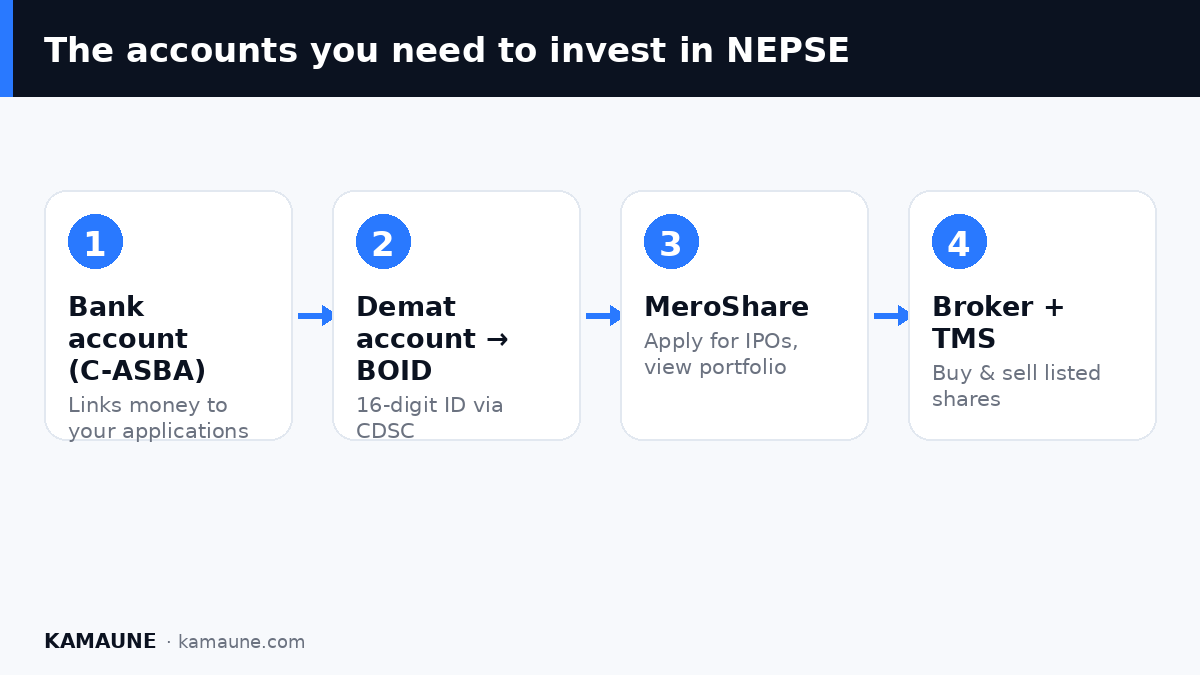
Before you can invest a single rupee, you need a small stack of accounts. Think of them as layers, each unlocking the next:
- A bank account — the foundation. Everything settles through your bank, and your IPO applications draw money from it.
- A Demat account — short for "dematerialised." It holds your shares electronically instead of as paper certificates. Opening one through CDSC (CDS and Clearing Ltd) gives you a 16-digit BOID (Beneficiary Owner Identification) — the number that identifies you across the whole system.
- A MeroShare account — the online portal at meroshare.cdsc.com.np where you apply for IPOs and view your holdings. It links to your Demat/BOID.
- A C-ASBA link — your bank connected to the system so that when you apply for an IPO, the money is blocked (and later either debited or released) automatically.
That covers the primary market. To trade shares that are already listed — the secondary market — you'll also need one more thing:
- A broker / trading account — opened with a licensed NEPSE broker, giving you access to the TMS (Trade Management System) where you actually place buy and sell orders.
If that list feels long, don't worry — you open the first four once and rarely touch them again. Our step-by-step for the demat and MeroShare setup covers documents, costs, and screens in detail: see how to open a Demat and MeroShare account in Nepal.
Two ways to invest
Here's the distinction that trips up almost every beginner. There are two separate markets, and you enter them differently.
Primary market — IPOs
When a company sells its shares to the public for the very first time, that's an Initial Public Offering (IPO). You apply through MeroShare (or mobile banking), and if there are more applicants than shares — which is almost always the case in Nepal — shares are distributed by a lottery-style allotment.
The appeal for beginners is the low entry cost: the minimum application is typically around 10 units, which works out to roughly NPR 1,000. If you're allotted, the shares land in your Demat account; if you're not, your blocked money is released back to you. It's a low-friction way to get your feet wet.
The full walkthrough — selecting the issue, entering units, authorising, and checking results — is here: how to apply for an IPO in Nepal.
Secondary market — buying and selling listed shares
Once a company is listed, its shares trade every business day on NEPSE at prices that move with supply and demand. This is where you buy shares of a company you want to own and sell when you choose. It requires the broker/TMS account, and it's where price research, timing, and discipline start to matter.
The mechanics of choosing a broker, logging into the TMS, and placing your first order are covered in how to buy and sell shares in Nepal.
Primary vs secondary — at a glance:
| Primary market (IPO) | Secondary market | |
|---|---|---|
| What you buy | New shares, first-time issue | Already-listed shares |
| Where | MeroShare / mobile banking | Broker's TMS |
| Price | Fixed issue price | Live market price |
| Who gets shares | Allotment (often a lottery) | Whoever places the order |
| Minimum to start | ~NPR 1,000 (10 units) | Cost of the shares + commission |
| Extra account needed | C-ASBA link | Broker / trading account |
How you actually make money from shares
New investors often picture only one path to profit — buy low, sell high. That's real, but it's not the whole story. Shares can reward you in a few distinct ways, and knowing them helps you judge whether a company suits your goal:
- Capital gains. The classic route: you buy shares and their market price rises, so selling returns more than you paid. This is where the secondary market and price research matter most, and it's taxed as a capital gain.
- Dividends. Many established companies distribute part of their profit to shareholders as a cash dividend. You earn this just for holding the shares — no selling required — though a withholding tax is deducted at source.
- Bonus and rights shares. Companies sometimes issue extra shares to existing holders (bonus shares) or offer them the chance to buy more at a set price (rights shares). Both are common in Nepal and can grow your holding over time.
A beginner-friendly frame: dividends and bonus shares reward patience, while capital gains reward good timing and research. Most long-term investors end up relying more on the first kind than the second — which is worth remembering before you chase a fast trade. For exactly how each of these is taxed, see tax on share market profit in Nepal.
What moves share prices (a beginner's mental model)
You don't need to become an analyst, but you should understand that a share price is not random and it is not a promise. Over time, prices tend to reflect how a company is actually performing — its profits, growth, and prospects. In the short term, they swing on sentiment, news, liquidity, and plain crowd behaviour, which is why a price can rise for weeks on hype and then correct sharply.
The practical takeaway for a beginner is discipline over prediction. You can't reliably time the daily swings, so anchor your decisions to what a company is worth and why, decide in advance how long you intend to hold, and don't let a group chat's excitement override your own reasoning. Prices falling is a normal part of the market, not a malfunction — which is exactly why you only invest money you won't need in a hurry.
Costs — commissions, fees, and taxes
Investing is never free, and knowing the deductions upfront stops nasty surprises.
- Broker commission: On secondary-market trades, brokers charge a commission that is typically in the range of ~0.3%–0.5% of the trade value (the exact rate is tiered and set within SEBON's framework — verify the current schedule with your broker).
- Other transaction fees: Small SEBON and NEPSE fees may apply on top of commission.
- Taxes: Profit on shares is subject to capital gains tax, and dividends are subject to a withholding tax — both generally deducted at source, so you don't have to chase paperwork for each trade. As of 2026, capital gains on listed shares are commonly cited at around 7.5% if held under 365 days and 5% if held a year or more for individuals, with dividend withholding around 5% — but rates change, so read the full breakdown and worked examples in tax on share market profit in Nepal and verify with the Inland Revenue Department.
How much to start with, and your first 3 months
You do not need lakhs of rupees to begin. A realistic, low-pressure path:
- Month 1 — set up and observe. Open your bank, Demat, and MeroShare accounts, link C-ASBA, and simply watch. Apply for one or two IPOs (roughly NPR 1,000 each) to learn the flow with almost no downside.
- Month 2 — open a broker account. With the paperwork done, add a trading account so you can access the secondary market when you're ready.
- Month 3 — make a small, deliberate first purchase. Buy a modest amount of a company you've actually read about — not one your group chat is hyping. The goal is learning the process, not getting rich this quarter.
Treat your first few months as tuition. The habits you build — reading before buying, keeping records, not betting money you need — matter far more than any single trade.
If you're still deciding whether shares even belong in your plan versus fixed deposits, gold, or mutual funds, compare them side by side in best investment options in Nepal.
Mistakes beginners make
- Going all-in on IPO hype. An IPO closing "tomorrow" is not a reason to empty your account. The minimum application exists so you can spread across many issues.
- Buying with zero research. In the secondary market, a rising price is not a plan. Understand what the company does and how it earns before you buy.
- Confusing the two markets. Applying for an IPO does not mean you can trade freely the next day — allotted shares settle first, and active trading needs a broker account.
- Ignoring costs and tax. Commission and capital gains quietly reduce your return. Factor them in from day one.
- Chasing "guaranteed" returns. No one can promise you a doubling. Anyone who does is a red flag, not an opportunity.
Frequently Asked Questions
How do I start investing in NEPSE?
Open a bank account, then a Demat account (which gives you a 16-digit BOID), register on MeroShare, and link C-ASBA. That lets you apply for IPOs. To buy and sell listed shares, add a broker/trading account with TMS access.
What's the minimum to invest?
For IPOs, the minimum application is typically around 10 units, or roughly NPR 1,000, as of 2026. For the secondary market, your minimum is simply the price of the shares you buy plus broker commission.
Is the share market safe for beginners?
The mechanics are safe and regulated by SEBON, but share prices carry real risk and can fall. Start small, only invest money you don't need soon, and never borrow to buy shares.
Do I pay tax on share profits?
Yes. Capital gains tax applies to profits and dividend tax applies to dividends, generally deducted at source. See our share market tax guide for current rates and examples, and verify with the IRD.
Conclusion
Investing in NEPSE comes down to a simple sequence: get your accounts in order, understand the difference between IPOs and the secondary market, start small, and keep costs and taxes in view. Do that, and the market stops feeling like a mysterious group-chat lottery and starts feeling like a tool you actually control.
Your very next step is the one everything else depends on — set up your Demat and MeroShare accounts, then apply for your first IPO.
This article is educational, not financial or legal advice. Rules, rates, and fees change — verify with the relevant official source (NEPSE, CDSC, SEBON, IRD) or a qualified professional before acting.
Get NEPSE explained without the jargon — every week. Join the Kamaune newsletter. Then start here: open your Demat and MeroShare account.