There's a specific moment in every Nepali investor's journey: you've been allotted some IPO shares, they're sitting in your Demat account, and you realise you have no idea how to actually sell them — or how to buy shares of that company everyone's talking about. That's the leap from the primary market to the secondary market, and it needs one thing you don't have yet: a broker account with access to the TMS.
This guide takes you from opening that trading account to placing your first buy and sell orders, understanding settlement, and knowing what it costs.
Primary vs secondary market — a quick recap
The primary market is IPOs: new shares, applied for through MeroShare, allotted by lottery. The secondary market is everything after that — shares that are already listed, trading at live prices every business day, bought and sold through a broker.
If IPOs are how you get in the door, the secondary market is where you actually choose what to own and when to exit. For the full picture of how both fit together, see how to invest in the share market in Nepal.
Open a broker / trading account
To trade on NEPSE you need an account with a licensed broker. There are 70-plus brokers operating in Nepal, so you have real choice. When comparing them, look at:
- Commission rate — within the regulated range, some are more competitive than others.
- Platform quality — how good their TMS access and any mobile app are.
- Service and support — responsiveness when you have a settlement or fund question.
- Convenience — a broker that's also your Demat DP keeps everything in one place.
You'll typically open the trading account with the same documents you used for your Demat account (citizenship/PAN/photo/bank details). If you haven't set up your Demat and MeroShare yet, do that first — here's how.
The TMS — logging in, funding, and placing a buy order
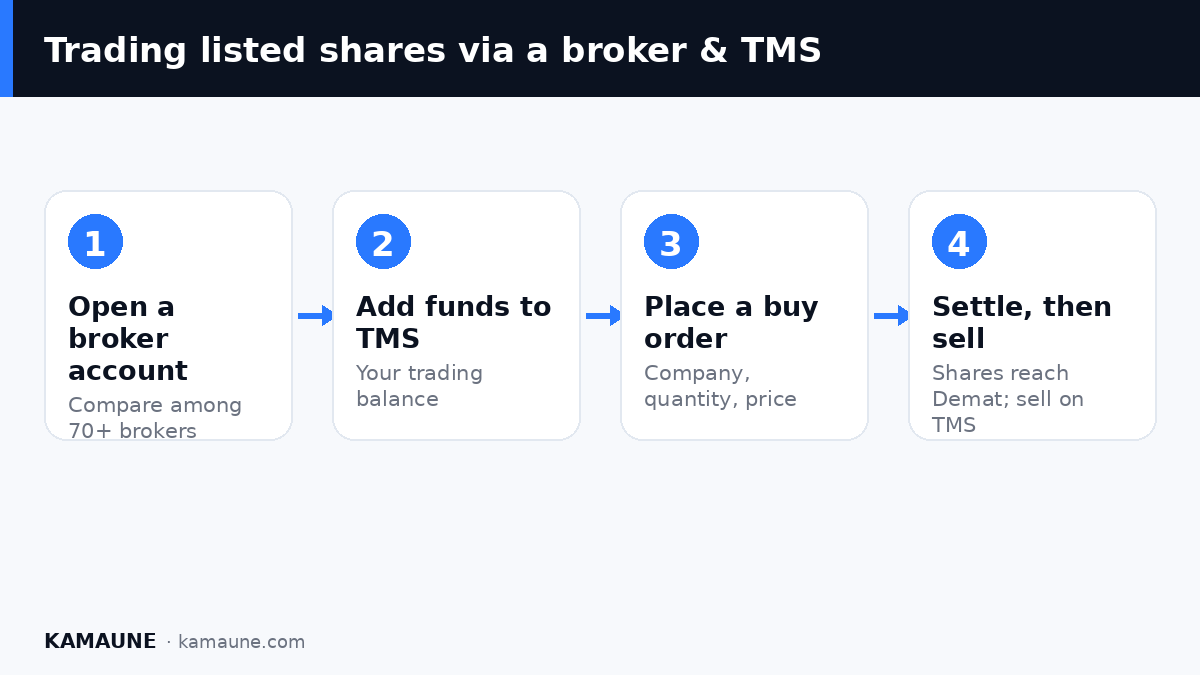
The TMS (Trade Management System) is the official platform where NEPSE trades are placed. Your broker gives you login credentials once your account is active. Remember that NEPSE trades Sunday to Thursday, roughly 10:00 to 15:00 Nepal time — orders happen within market hours.
To place a buy order:
- Log in to the TMS with the credentials from your broker.
- Make sure your trading account is funded (transfer money to your broker as they instruct).
- Search for the company by its stock symbol.
- Enter the quantity and your price (the rate you're willing to pay).
- Confirm and submit the order. It executes when a matching seller is found at your price.
📷 Image to add: NEPSE TMS buy order screen showing stock symbol, quantity, and price fields
Placing a sell order and settlement
Selling works the same way in reverse — search the symbol, enter the quantity and your asking price, and submit a sell order. This is exactly how you sell the shares you were allotted in an IPO, once they're listed.
After a trade executes, it goes through settlement — the process where shares and money actually change hands, which happens over a set cycle (a "T+" number of days after the trade). The exact settlement cycle is set by NEPSE and can change, so confirm the current cycle on nepalstock.com rather than assuming. Until settlement completes, sale proceeds aren't fully in your hands.
Costs — commission, fees, and tax
Every secondary-market trade carries costs:
- Broker commission: typically in the range of ~0.3%–0.5% of the trade value (it's tiered and set within SEBON's framework — check your broker's current schedule).
- Other fees: small SEBON and NEPSE charges may apply.
- Capital gains tax: deducted when you sell at a profit. As of 2026, it's commonly cited at around 7.5% for holdings under 365 days and 5% for holdings of a year or more (individuals) — but this changes, so read the full breakdown in tax on share market profit in Nepal and verify with the Inland Revenue Department.
Because commission applies on both the buy and the sell, and tax on the gain, factor them in before you decide a trade is "worth it."
Reading a stock before you buy (basic checks, not tips)
This guide won't tell you what to buy — no one honest will. But before you place an order, do a few basic checks: understand what the company actually does and how it makes money, look at its financial reports and disclosures, and be wary of buying purely because a price is rising or a group chat is excited. A rising price is not a reason on its own.
If you're new to the whole journey and want the roadmap of how accounts, IPOs, and trading fit together, step back to how to invest in the share market in Nepal.
Common mistakes new traders make
The secondary market is less forgiving than IPOs, so a few habits protect you early on:
- Chasing a rising price. Buying only because a share has been going up — with no idea why — is how beginners get caught at the top. Understand the company first.
- Ignoring commission on both sides. Commission applies when you buy and when you sell, so a tiny price move may not even cover your costs. Factor in the round trip before you trade.
- Forgetting the settlement cycle. Sale proceeds aren't instantly spendable — they clear over the settlement cycle. Don't commit money you haven't actually received yet.
- Trading outside a plan. Decide why you're buying and roughly when you'd sell before you place the order, rather than reacting to every daily swing.
- Treating tips as research. A hot tip from a group chat is not analysis. No one can reliably promise you a winning trade — be especially wary of anyone who does.
Start with one small, deliberate trade to learn the flow, and scale up only once the process feels routine.
Frequently Asked Questions
How do I choose a broker?
Compare commission rates, platform and app quality, customer support, and convenience — using a broker that's also your Demat DP keeps things simple. With 70-plus licensed brokers, you have plenty of choice.
What is TMS?
The Trade Management System is NEPSE's official online platform where you place buy and sell orders. Your broker issues your TMS login once your trading account is active.
How long does it take to sell after buying?
You can place a sell order any time the market is open, but the trade then goes through a settlement cycle (a set number of days) before money and shares fully change hands. Verify the current cycle on nepalstock.com.
What's the commission?
Broker commission is typically in the ~0.3%–0.5% range of trade value, set within SEBON's tiered framework. Confirm your broker's exact current schedule.
Conclusion
Buying and selling on NEPSE is really just three moving parts: a broker account, the TMS, and an awareness of the costs that eat into each trade. Open the account, learn the buy and sell flow with a small first order, respect the settlement cycle, and always do your basic homework before you click. That's the difference between trading and gambling.
This article is educational, not financial or legal advice. Rules, rates, and fees change — verify with the relevant official source (NEPSE, SEBON, IRD) or a qualified professional before acting.
Learn the market's mechanics without the noise — join the Kamaune newsletter. Before you sell, know your tax: tax on share market profit in Nepal.