
For most Nepalis, the very first rupee they ever put into the share market goes into an IPO. It's the natural entry point: the amount is tiny, the process takes minutes, and if you don't get allotted, your money comes straight back. The only real hurdle is the first time — once you've clicked through the MeroShare screens once, you'll do it in under two minutes for every future issue.
This walkthrough covers what an IPO actually is, exactly how to apply through MeroShare (and via mobile banking), how allotment and results work, and the question everyone eventually asks: "I wasn't allotted — now what?"
What an IPO is, and why it's the beginner entry point
An Initial Public Offering (IPO) is when a company sells shares to the public for the first time at a fixed price. In Nepal, demand almost always exceeds the number of shares on offer, so instead of first-come-first-served, shares are handed out through an allotment — effectively a lottery among valid applicants.
That structure is what makes IPOs beginner-friendly. You're not timing a volatile market or picking an entry price; you apply for the minimum, and you either get a small allotment or a full refund. The mechanics carry very little downside, which is why they're where people learn the ropes.
Before you apply
You need three things already in place:
- A Demat account (with your 16-digit BOID)
- A MeroShare login
- A C-ASBA-linked bank account with enough balance to cover the application
If any of those aren't set up yet, sort them first — the full setup is in how to open a Demat and MeroShare account in Nepal. Make sure the bank account you linked actually has the money, because C-ASBA blocks the amount from that account when you apply.
Step-by-step in MeroShare
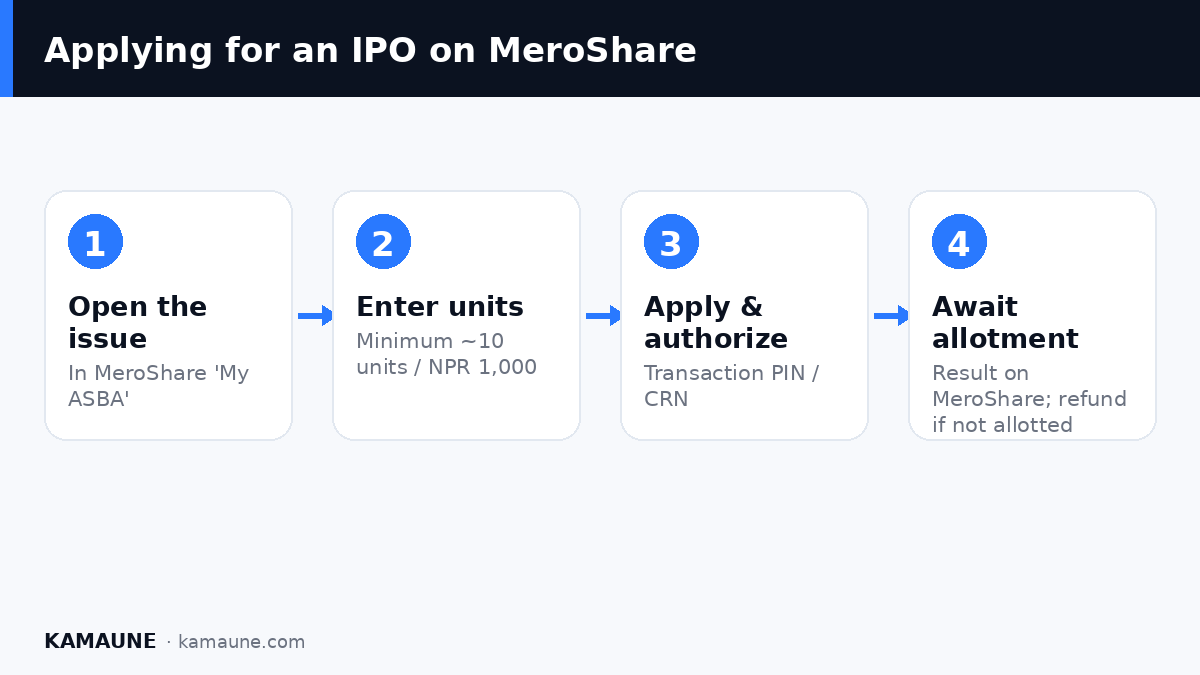
Once an IPO is open (issues are open for a limited window), here's the flow:
- Log in to meroshare.cdsc.com.np with your username, password, and DP.
- Go to the "My ASBA" section, where open issues are listed.
- Select the IPO you want and click Apply.
- Choose your bank account (the C-ASBA-linked one) and enter the number of units you want. The minimum is typically around 10 units, which is roughly NPR 1,000 as of 2026.
- Enter your CRN number (from your bank) and set/enter your transaction PIN.
- Review the details and submit to authorise the application.
📷 Image to add: MeroShare IPO application screen showing the units field and bank selection
That's it — the amount is now blocked in your account until results are declared. Verify the current minimum and any process changes on CDSC or with your bank, as these details are periodically updated.
Alternative — applying via mobile banking
You don't strictly need to open MeroShare. Many Nepali banks let you apply for open IPOs directly inside their mobile banking apps, using the same C-ASBA mechanism behind the scenes. The steps differ slightly by bank, but you'll generally find an "IPO/Share" or "ASBA" menu, select the open issue, enter your units, and authorise. It's a handy backup when you're away from a computer.
Allotment and results
After the issue closes, the allotment is processed and results are published — typically on MeroShare a few business days after the close (the exact timing varies by issue, so check the issue notice). You can see whether you were allotted directly in your MeroShare account, and allotted shares appear in your Demat holdings.
"I wasn't allotted — now what?"
This is the most common outcome, and it's completely normal — heavy demand means most applicants get nothing or only a small allotment.
Here's the key reassurance: if you're not allotted, the money that was blocked is released back to your account. You don't lose it, and you don't have to file for a refund — it simply unblocks. C-ASBA handles that automatically.
The practical strategy most regular investors follow is simple: apply for the minimum on nearly every issue you're eligible for. Each application costs you only the temporary blocking of about NPR 1,000, and over many issues, the occasional allotment adds up with almost no risk. Just make sure the linked account stays funded so applications don't fail.
Common IPO application mistakes
Most failed or rejected applications come down to avoidable errors:
- Insufficient balance. C-ASBA can only block money that's actually there. If your linked account doesn't hold enough to cover the units you applied for, the application won't go through.
- Applying more than once from the same identity. You apply once per issue against your BOID — duplicate applications from the same person are not the way to improve your odds, and can be rejected.
- Wrong CRN or forgotten PIN. These are required to authorise. Have your bank's CRN ready and remember your MeroShare transaction PIN before the issue closes.
- Waiting until the last hour. Issues stay open for a limited window. Leaving it to the final moments risks a rush, a login problem, or a funding delay costing you the application.
- Over-applying for units. More units doesn't guarantee a bigger allotment when demand is heavy, and it blocks more of your money. Many regular investors simply apply for the minimum across many issues.
None of these are complicated — they're just the details worth double-checking the first few times.
After allotment — where the shares go, and when you can sell
Allotted shares are credited to your Demat account and show up in MeroShare. They aren't instantly tradable the moment they're allotted — the company's shares become sellable once they're listed and settled on NEPSE, and you'll need a broker/trading account to sell them.
When you're ready to sell those shares (or buy others on the open market), the full process is in how to buy and sell shares in Nepal. And before you sell at a profit, know what's deducted — see tax on share market profit in Nepal.
Frequently Asked Questions
What's the minimum IPO amount?
As of 2026, the minimum application is typically around 10 units, which comes to roughly NPR 1,000. Verify the current minimum for each issue, as it can vary.
How do I check IPO results?
Results are published on MeroShare, usually a few business days after the issue closes. Log in and check your application status, or use an official result-checking service. Confirm timing from the issue notice.
Why wasn't I allotted shares?
Because demand almost always exceeds supply, shares are distributed by allotment (a lottery among valid applicants). Not being allotted is common and simply means your blocked money is released back to you.
When can I sell allotted shares?
Once the shares are listed and settled on NEPSE, and you have a broker/trading account. You can't sell them the instant they're allotted — see our buy and sell shares guide.
Conclusion
Applying for an IPO in Nepal is one of the lowest-risk ways to start participating in the market: set up your accounts once, apply for the minimum through MeroShare or your bank's app, and let C-ASBA handle the blocking and refunds. Not getting allotted isn't a loss — it's just your money coming back, ready for the next issue.
This article is educational, not financial or legal advice. Rules, rates, and fees change — verify with the relevant official source (CDSC, NEPSE, SEBON) or a qualified professional before acting.
Never miss an IPO opening — join the Kamaune newsletter. Ready to sell what you're allotted? Learn how to buy and sell shares.