The YouTube version of starting an online business is a person in a nice room saying "just find a winning product and run ads." The Nepal version has three details that version leaves out: how a customer actually pays you, whether the parcel actually arrives, and what cash-on-delivery does to your money and your returns. Ignore those and you don't have a business — you have a losing hobby with a logo.
This guide is built around those realities. The models below can work in Nepal, but each comes with the local frictions named honestly, plus how to handle payments, delivery, and registration so you don't learn them the expensive way. If you're still choosing what to sell, our pillar on low-investment small business ideas in Nepal is the wider menu; this piece is specifically about doing it online.
Online business models that work in Nepal
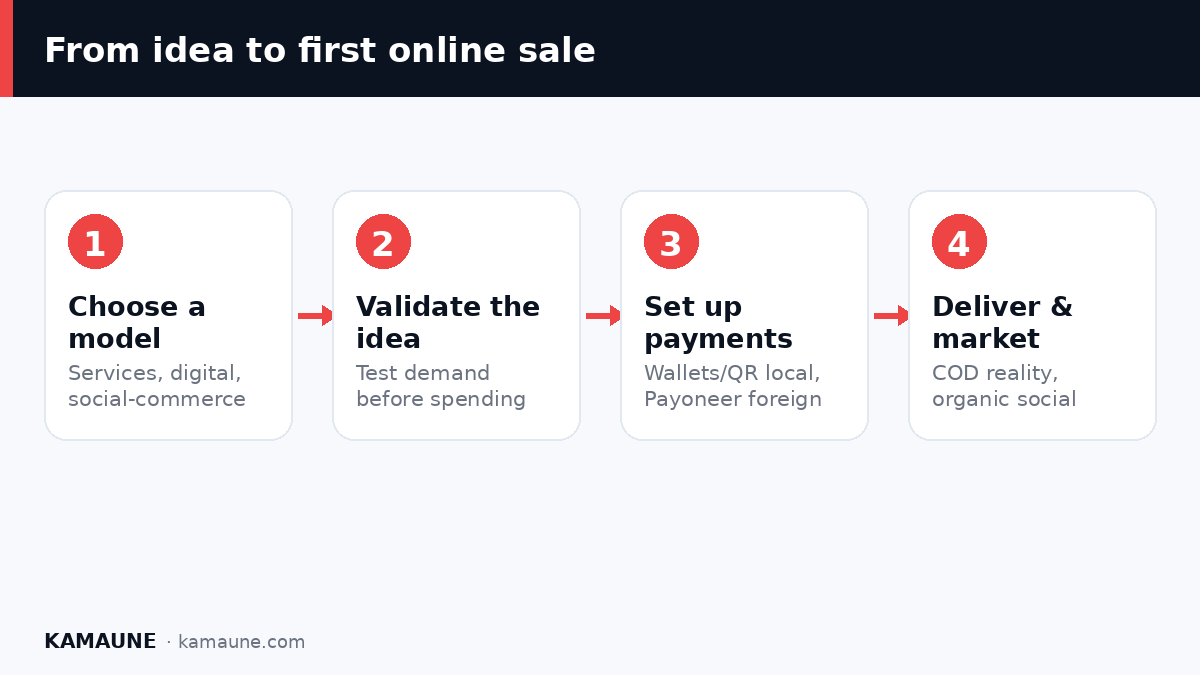
Not all online models are equal here. Roughly from lowest-friction to highest:
- Digital services (lowest friction). Design, marketing, writing, web, video — sold to clients local or abroad. No inventory, no shipping, no customs. This is the easiest online business to start and the hardest to lose money on, because your only real cost is your time.
- Digital products. Courses, templates, ebooks, presets. Build once, sell many times. The challenge is marketing and payment collection, not logistics.
- Social-commerce. Selling physical goods directly through Instagram, Facebook, and TikTok to an audience you build. This is how a huge share of Nepal's small online sellers actually operate — no separate website needed.
- Ecommerce store. Your own site or a marketplace listing. More setup and marketing, more control.
- Dropshipping (highest friction — read the caveats). Selling products you don't stock, shipped by a supplier. In Nepal this runs into customs on imported goods, slow and unreliable last-mile delivery, and heavy COD returns. It's possible, but it's the model most likely to quietly drain your cash. Go in with eyes open.
If a service model fits your skills, that's usually the smartest first online business — and it overlaps with freelancing, covered in the online-earning cluster.
Validate the idea before you spend
The cheapest business mistake to avoid is buying stock or building a store for something nobody wants. Before you spend real money:
- Pre-sell or take orders first. Post the product or service to your audience and see if anyone actually commits before you stock it.
- Start with a tiny batch. For physical goods, buy the smallest quantity you can, sell it, and only reorder what moves.
- Talk to ten potential customers. Ask what they'd pay and what would stop them buying. Their objections are your to-do list.
Validation isn't a step you skip because you're excited. It's the step that decides whether the excitement was justified.
Payments: how you actually get paid
This is where Nepal-specific reality bites hardest, so sort it first.
- Local customers: digital wallets (eSewa, Khalti, IME Pay), ConnectIPS, and QR payments cover most transactions. Cash-on-delivery is still huge, especially outside major cities. Compare the wallets in the best digital wallet in Nepal guide and offer the ones your customers already use.
- Foreign customers: you cannot receive into PayPal in Nepal. Use Payoneer or Wise, then withdraw to your Nepali bank. The full method — setup, fees, which platforms it works with — is in how to get paid from abroad in Nepal.
Decide your payment methods before you announce you're open, so your first sale doesn't get stuck.
Logistics, delivery, and the COD reality
If you sell physical products, delivery and cash-on-delivery will shape your whole business:
- Delivery is uneven. Reliable inside major cities, slower and patchier outside them. Set honest delivery timelines with a courier you've tested.
- COD ties up your cash. Money is collected on delivery, then remitted to you by the courier after a delay — so your capital is locked in transit.
- COD inflates returns. Buyers who haven't paid upfront refuse parcels more often. Every refused COD order costs you the round-trip shipping and leaves you holding stock.
The practical response: prefer prepaid where you can (a small discount for advance payment via wallet/QR nudges buyers), keep stock lean, and factor return costs into your pricing from day one.
Registration and tax
Once you're taking real, regular orders, operate formally. For most solo online sellers that means a sole proprietorship (private firm) and a business PAN; the PAN is what lets you invoice and file tax correctly. The full walkthrough — structures, documents, cost, PAN, and when VAT applies — is in how to register a business in Nepal.
Don't treat this as optional once income is meaningful. It's cheaper and simpler than founders assume, and it's the difference between a business and an untracked cash flow.
Marketing on a budget
You don't need an ad budget to start — you need attention you earn:
- Organic social first. Consistent posts, real product photos, replies to every comment and DM. This is free and, in Nepal's social-commerce culture, often more effective than ads for a new seller.
- Content that pulls people in. Short video, useful posts, behind-the-scenes. If content becomes a channel in its own right, our guide to earning from YouTube and blogging in Nepal covers turning an audience into income.
- Paid ads later. Once you know a product sells organically, a small boost budget amplifies what already works — not a substitute for it.
Frequently Asked Questions
Is dropshipping possible in Nepal?
Possible, but it's the hardest online model here. Importing products means customs and long delivery times, last-mile delivery is uneven outside major cities, and the cash-on-delivery culture drives up refused parcels and returns. If you try it, keep it lean, test suppliers carefully, and don't count on the effortless version you see in foreign tutorials.
Do I need to register an online business in Nepal?
Once you're taking regular, meaningful orders, yes — typically a sole proprietorship and a business PAN so you can invoice and file tax. See how to register a business in Nepal for the process and cost, and verify current rules with the IRD.
How do online stores in Nepal get paid?
Local customers pay via digital wallets (eSewa, Khalti, IME Pay), ConnectIPS, QR, or cash-on-delivery. Foreign customers pay via Payoneer or Wise, which you withdraw to a Nepali bank — PayPal can't receive into Nepal. See the digital wallet comparison and the getting-paid-from-abroad guide.
Conclusion
An online business in Nepal is entirely doable — the winners just plan around the local realities instead of pretending they don't exist. Favor low-friction models (services and social-commerce over import-dropshipping), validate before you spend, sort payments and delivery before your first sale, and register once income is real.
Choose one model that fits your skills and cash, set up how you'll get paid, and make one sale before you optimize anything.
Want the full menu of ideas to start from? See low-investment small business ideas in Nepal, and join the Kamaune newsletter for practical Nepal-focused business guidance each week.