Ask almost anyone in Nepal why they don't save and you'll hear the same sentence: "I'll save whatever is left at the end of the month." The trouble is that nothing is ever left. Rent, food, a wedding invitation, a phone that finally died, a cousin who needed a loan — the month always finds a way to spend the leftover. Saving what remains is a plan to save nothing.
The fix isn't earning more or living like a monk. It's flipping the order: you save first, then live on the rest. Do that, and even a modest salary quietly builds a cushion. This guide shows you how — the payday habit that makes saving automatic, how big your emergency fund should be, where to keep it, and how to save when your income is small or irregular.
Pay yourself first
This is the whole game in three words. Instead of spending and hoping to save the remainder, move your savings out the moment your income arrives — before rent, before anything. Treat your savings like a bill you owe yourself, and pay it first.
In practice: the day your salary lands, transfer a fixed amount to a separate savings account. Set up a standing instruction or an automatic transfer so you don't have to decide each month — because the month you decide is the month you skip. Start with an amount you won't feel too sharply (even 5–10% of income), then raise it. What leaves your account before you see it as "spendable" is what you'll actually keep. This works best alongside a plan for the rest of your money — see our guide on how to make a budget in Nepal.
How big should your emergency fund be?
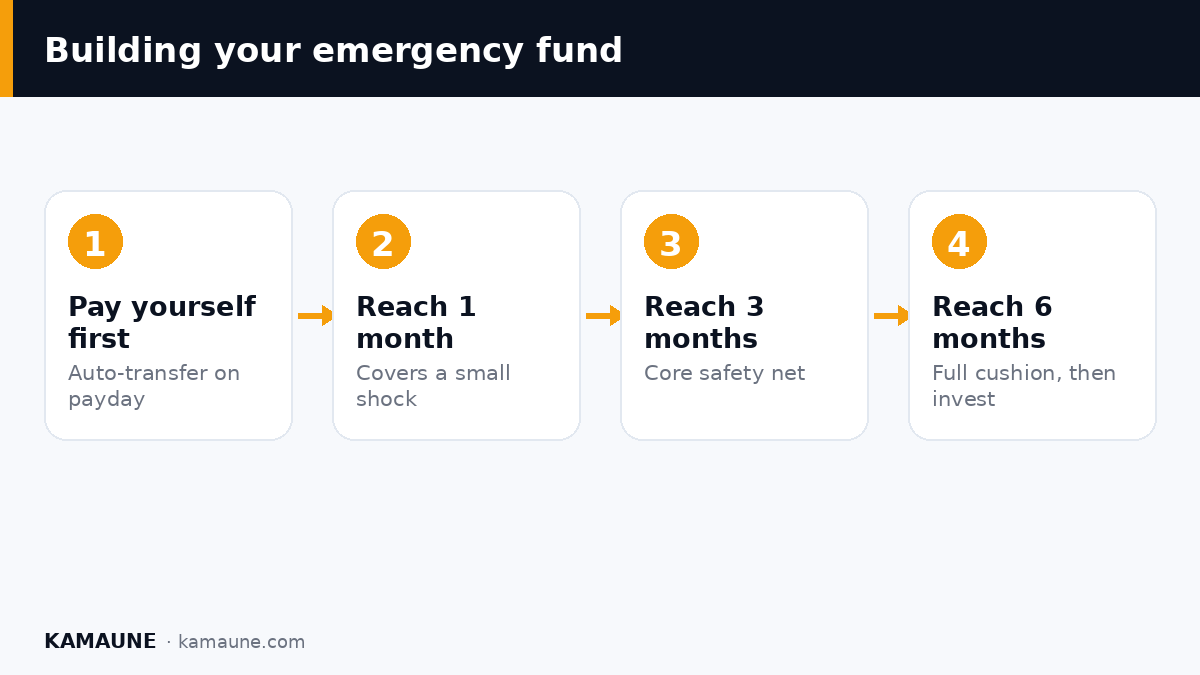
Your first savings goal isn't a car or a trip — it's an emergency fund: money reserved only for genuine crises, like losing your job, a medical bill, or an urgent family need. The standard target is 3 to 6 months of your essential expenses.
Note the word expenses, not income. You're covering what it costs to keep the lights on if income stops — not your full lifestyle. Work it out like this:
- Add up your essential monthly costs: rent, food, utilities, transport, minimum loan payments, family support. Say that's NPR 25,000 a month.
- 3-month fund: NPR 25,000 × 3 = NPR 75,000 (a solid starter goal).
- 6-month fund: NPR 25,000 × 6 = NPR 150,000 (fuller protection).
Aim for three months first; it's a realistic milestone that already changes how safe you feel. Build toward six over time. If your income is irregular or your job is less secure, lean toward the six-month end.
Where to keep your emergency fund
An emergency fund has one job: be there, in full, the instant you need it. That rules out anything risky or slow to access. Judge the options by liquidity and safety, not by return:
- Savings account — the natural home. Instant access, safe, low interest. Best for most of your emergency fund.
- Short-term / breakable fixed deposit — a portion can go here for slightly more interest, but only if you can break it without a crippling penalty. Don't lock the whole fund.
- Digital wallet — no. Convenient for spending, but never the place for your emergency fund. Keep only spending money in a wallet — see our comparison of the best digital wallets in Nepal for why wallets are for spending, not storing.
The emergency fund is explicitly not an investment. Don't put it in shares or long-term products where its value can drop or you can't reach it fast — that defeats the entire purpose. Investing is for the surplus that comes after the fund is full.
Practical Nepal-specific saving tactics
Beyond the payday transfer, small habits add up:
- Hunt down hidden recurring costs. Unused subscriptions, an over-sized data pack, autopay on services you forgot — cancel them. Each is a small monthly leak.
- Cook more, order less. Food delivery is the quiet budget-killer for young earners. Even shifting a few orders a week to home cooking adds real money to savings.
- Plan festival and wedding spending. Dashain, Tihar, and the wedding season wreck budgets because they hit all at once. Set aside a little every month into a "festival fund" so December doesn't undo the year.
- Buy quality once for things you use daily. Cheap-and-replace often costs more over a year than buy-well-once.
A word on dhukuti (rotating savings). Informal rotating-savings groups are common and can enforce discipline, but they carry real risk: they're unregulated, depend entirely on trust, and people do lose money when an organizer defaults or the chain collapses. If you join one, only with people you deeply trust, only money you can afford to lose, and never as a substitute for a proper emergency fund in a bank.
Saving on a small or irregular income
If money is tight or unpredictable, the "pay yourself first" habit matters more, not less — but you adapt it:
- On a low salary, shrink the percentage, not the habit. Saving NPR 500 a month reliably beats intending to save NPR 5,000 and never doing it. The habit compounds; raise the amount as income grows.
- On an irregular/freelance income, save a percentage of each payment the moment it arrives, rather than a fixed monthly figure. When a client pays, skim your savings slice off the top before the money mixes into spending. Our guide to freelancing in Nepal covers managing that bumpy income.
- Save windfalls, don't spend them. Bonuses, Dashain kharcha, gift money, a tax refund — route a big chunk straight to the emergency fund before it's absorbed into daily spending.
Once your fund is full — what next?
When your emergency fund hits the 3–6 month target, congratulations — you've built the foundation most people never do. Now you have a decision: keep piling money into a low-interest savings account, where inflation slowly erodes it, or start putting the surplus to work.
That surplus — money beyond your emergency fund that you won't need soon — is what belongs in investments. To see the honest options and how they compare on risk and return, read our guide to the best investment options in Nepal. Saving builds the safety net; investing is how you grow what's left over. Both are part of managing your money well in Nepal.
Frequently Asked Questions
How much emergency fund do I need?
Aim for 3 to 6 months of your essential monthly expenses (rent, food, utilities, transport, minimum loan payments) — not your full income. If your essentials are NPR 25,000 a month, that's NPR 75,000 to NPR 150,000. Start with the three-month goal, then build toward six, and lean toward six if your income is irregular or your job less secure.
Where should I keep my emergency fund?
In a liquid, safe place you can access instantly — mainly a bank savings account. A portion can sit in a short-term fixed deposit for a little more interest, as long as you can break it without a heavy penalty. Never keep it in a digital wallet or in investments like shares, where value can drop or access is slow.
How can I save on a low salary?
Save a small fixed amount automatically on payday, before spending — even NPR 500 builds the habit — and raise it as income grows. Cut hidden recurring costs, cook more instead of ordering, and route any windfall (bonus, gift money) straight to savings. Consistency beats the amount.
Is dhukuti safe?
Dhukuti (rotating savings) can enforce saving discipline, but it's unregulated and built entirely on trust — people do lose money when an organizer defaults. Only join with people you deeply trust, only with money you can afford to lose, and never treat it as a replacement for a proper emergency fund held in a bank.
Conclusion
Saving in Nepal isn't about willpower at the end of the month — it's about moving money out on payday before it can disappear, building a 3–6 month emergency fund, and keeping that fund somewhere safe and liquid. Start this month: automate one transfer, however small, and let the habit do the work. Once the fund is full, the surplus is ready to grow.
Fund's ready? Grow it — see the honest comparison in our guide to the best investment options in Nepal, and join the Kamaune newsletter for practical saving and money tips every week.