Most budgeting advice you'll find online was written for someone with one salary, one bank account, and every expense on a card. That's not Nepal. Here, you might pay rent in cash, top up your phone on eSewa, get part of your income as freelance payments that land whenever a client feels like paying, and send money home to parents every month without ever calling it a "bill." A budget copied from a foreign blog ignores all of that — which is exactly why it lasts about eleven days before you give up.
This guide builds a budget around how money actually moves in Nepal. You'll track a real month, split it with a rule you can adapt, handle irregular income, automate the saving, and copy a template you can fill in tonight. Budgeting is the second step in the bigger picture of managing your money in Nepal — the fastest one to see results.
Step 1 — Track a month before you plan a rupee
You cannot budget money you can't see. Before deciding anything, track everything you spend for one full month, across all three places your money lives:
- Cash — write it down the moment you spend, or you'll forget the NPR 50 chiya and NPR 300 taxi.
- Digital wallets — eSewa, Khalti, IME Pay. Check the transaction history in each app.
- Bank account — statement or mobile banking history for card, transfers, and auto-debits.
Group what you find into simple buckets: rent, food/groceries, transport, utilities, family support, eating out, subscriptions, shopping, loan payments. Don't judge yet — just record. Most people discover two things: they spend more on food delivery than they thought, and small daily cash spends add up to a shocking monthly total. If you use several wallets, our comparison of the best digital wallets in Nepal can help you consolidate to fewer apps so tracking is easier.
Step 2 — Split it with the 50/30/20 rule (adapted)
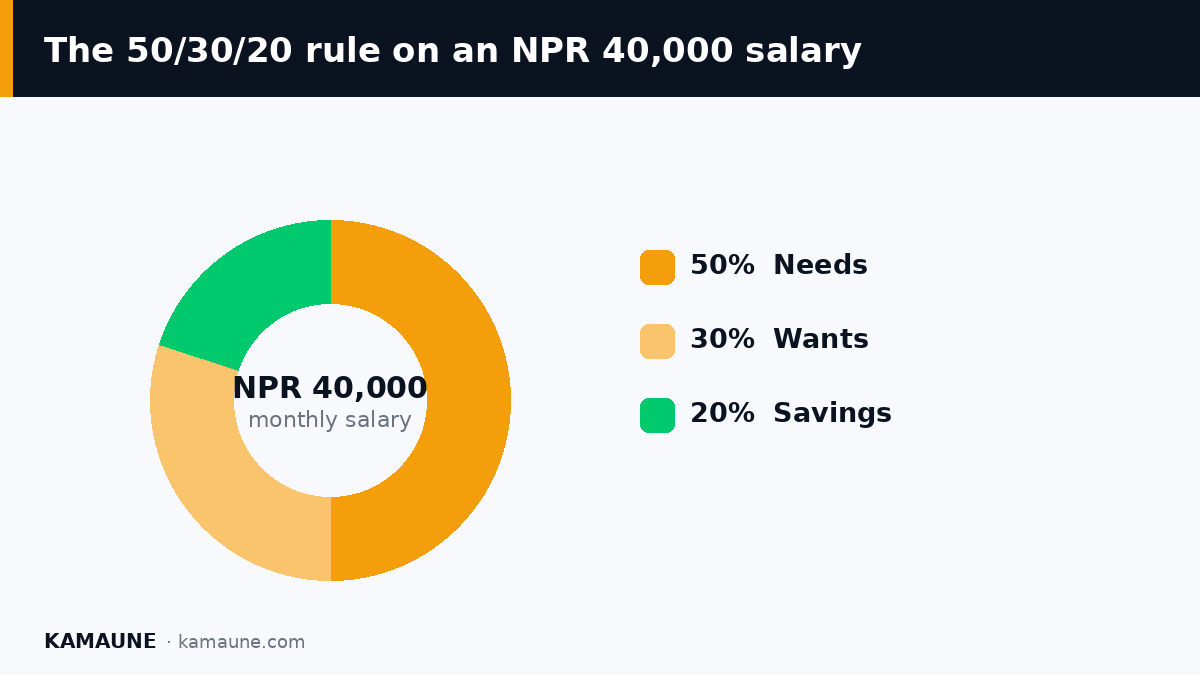
Once you know where money goes, give every rupee a job. The 50/30/20 rule is the easiest starting frame: 50% of take-home pay to needs, 30% to wants, 20% to savings and debt payoff.
Here it is on an NPR 40,000 monthly take-home salary:
| Category | Share | Amount | What goes here |
|---|---|---|---|
| Needs | 50% | NPR 20,000 | Rent, food, utilities, transport, minimum loan payments, family support |
| Wants | 30% | NPR 12,000 | Eating out, subscriptions, outings, gadgets, shopping |
| Savings & debt payoff | 20% | NPR 8,000 | Emergency fund, investments, extra loan payments |
Adapt it — don't obey it blindly. In Kathmandu, rent alone can push "needs" well past 50%. If that's you, the fix is to cut wants, not savings. Some months a festival or a wedding blows up the "wants" line — plan for those as their own sinking fund (put aside a little each month for Dashain-Tihar so it doesn't wreck one month's budget). The percentages are a starting point; the discipline of naming every rupee is the real win.
Step 3 — Budgeting with irregular or freelance income
If your income swings month to month — freelancers, commission earners, seasonal workers — a percentage of "this month's income" is useless when you don't know what this month's income is. Use the pay-yourself-a-salary method instead:
- Look back over the last 6–12 months and find your lowest typical monthly income. Call that your baseline.
- Build your budget on that baseline salary, not your best month.
- When a good month comes, the extra goes into a buffer account — not into lifestyle.
- Pay yourself a fixed "salary" from that buffer each month, so your spending stays steady even when income doesn't.
This turns a bumpy income into a predictable one. If you freelance, our guide to freelancing in Nepal covers the income side; the budgeting side is the same method above. The buffer also doubles as your first line of defense before the emergency fund kicks in.
Step 4 — Automate the saving
The single biggest reason budgets fail: people save whatever is left at month's end, and nothing is ever left. Flip it. Pay yourself first — move your savings amount out the day you get paid, before you spend anything.
Set up a standing instruction or a payday transfer from your salary account to a separate savings account. If your bank supports it, automate it so you never see the money as "spendable." What you don't see, you don't spend. This one change does more than any spending cut. The full method for building your cushion is in our guide on how to save money and build an emergency fund in Nepal.
Step 5 — Your free budget template
Copy this into a notebook, your phone's notes, or a simple spreadsheet, and fill in your own numbers. This example uses the NPR 40,000 salary from above:
| Line item | Budgeted (NPR) | Actual (NPR) | Difference |
|---|---|---|---|
| INCOME | |||
| Take-home salary / income | 40,000 | ||
| NEEDS (target 50%) | 20,000 | ||
| Rent | 10,000 | ||
| Food & groceries | 6,000 | ||
| Utilities (electricity, water, internet) | 2,000 | ||
| Transport | 2,000 | ||
| WANTS (target 30%) | 12,000 | ||
| Eating out & khaja | 4,000 | ||
| Subscriptions (streaming, apps) | 1,000 | ||
| Outings & shopping | 7,000 | ||
| SAVINGS & DEBT (target 20%) | 8,000 | ||
| Emergency fund | 5,000 | ||
| Investments | 2,000 | ||
| Extra loan payment | 1,000 | ||
| TOTAL | 40,000 |
Fill the "Budgeted" column at the start of the month, the "Actual" column as you spend, and review the "Difference" at month-end. Where actual beats budget, move the surplus to savings. Where it overshoots, adjust next month. The template is a living plan, not a one-time exercise.
Tools and apps
You don't need a fancy app to budget — a notebook or your phone's default notes app works, and a free spreadsheet (Google Sheets on your phone) handles the template above nicely. If you prefer an app, look for one that lets you add transactions manually (since cash and multiple wallets won't auto-import in Nepal) and shows category totals. The best budgeting tool is the one you'll actually open every day; simplicity beats features.
Frequently Asked Questions
How much should go to savings each month?
A common target is 20% of take-home pay, but start with whatever you can keep consistently — even 5–10% builds the habit. Raise the percentage as your income grows or your expenses fall. The key is to save first, on payday, not with whatever is left over.
How do I budget with an irregular income?
Budget on your lowest typical month, not your best one. In good months, sweep the extra into a buffer account and pay yourself a fixed monthly "salary" from it. This smooths a bumpy freelance or commission income into a predictable one you can budget against.
What's the best budgeting app in Nepal?
There's no single best app — what matters is that it supports manual entry (for cash and wallet spends that won't auto-sync in Nepal) and shows clear category totals. A free spreadsheet or your phone's notes app is enough for most people. Pick the tool you'll open daily and stick with it.
Conclusion
A budget that works in Nepal starts by seeing your real spending across cash, wallets, and bank, splits it with an adaptable 50/30/20 frame, handles irregular income by paying yourself a steady salary, and automates the saving so it happens first. Fill in the template above tonight with your own numbers — that single act puts you ahead of most people, who budget in their heads and wonder where the money went.
Build your safety net next — read our guide on how to save money and build an emergency fund in Nepal, and join the Kamaune newsletter for practical money habits every week.