

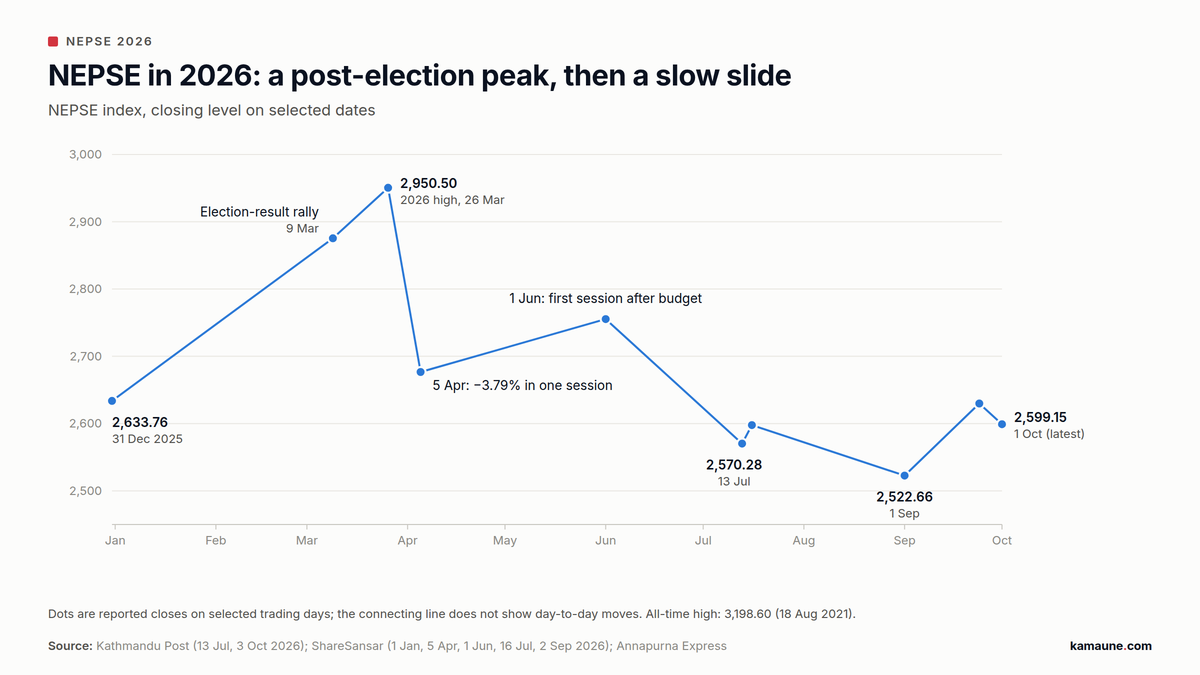
On 26 March 2026, the day before the new government took office, NEPSE closed at 2,950.50. Six months later, in the week ending 1 October, it closed at 2,599.15, about 12% lower. On an average day that week, investors traded only about Rs 4.5 billion of shares, a third of what they were trading before the change of government (Kathmandu Post).
What makes this strange is that the money is there. Banks are sitting on more than Rs 1 trillion they can't lend. Lending rates are at multi-year lows. Remittances grew 37% last fiscal year. Those conditions usually come before a stock-market rally, yet NEPSE is drifting lower on thin trading.
So why is NEPSE falling, and why can't it hold a rally? The short answer is that there isn't one cause. There are ten, and they feed into each other.
What is happening to NEPSE in 2026?
First, let's be precise. NEPSE has not crashed in 2026. It has fallen from a post-election peak and then stalled. That is a different problem with different causes.
| Indicator | Figure | Date | Source |
|---|---|---|---|
| NEPSE close | 2,599.15 | Week ending 1 Oct 2026 | Kathmandu Post |
| 2026 closing high | 2,950.50 | 26 Mar 2026 | Kathmandu Post |
| Change from 2026 high | about −12% | — | Kamaune calculation |
| Change in 2026 so far (vs 2,633.76 on 31 Dec 2025) | about −1.3% | — | ShareSansar / calculation |
| All-time high | 3,198.60 | 18 Aug 2021 | ShareSansar |
| Market capitalisation | Rs 4.47 trillion (down from Rs 5.009 trillion on 26 Mar) | 1 Oct 2026 | Kathmandu Post |
| Average daily turnover | Rs 4.50 billion (down 26% from the week before) | Week ending 1 Oct 2026 | Kathmandu Post |
| Fiscal year 2082/83 return | −7.05% (2,794.78 → 2,597.80) | Mid-Jul 2025 → mid-Jul 2026 | ShareSansar |
Here is the 2026 story in brief:
- March: the general election on 5 March gave the RSP a single-party majority. NEPSE rallied hard, rising 6% in one session on 9 March, and peaked in late March.
- First 106 days of the new government: the index lost more than 380 points and nearly Rs 600 billion in market value. It fell on 47 of 73 trading days (Kathmandu Post).
- Since mid-July: it has moved sideways between roughly 2,510 and 2,680.
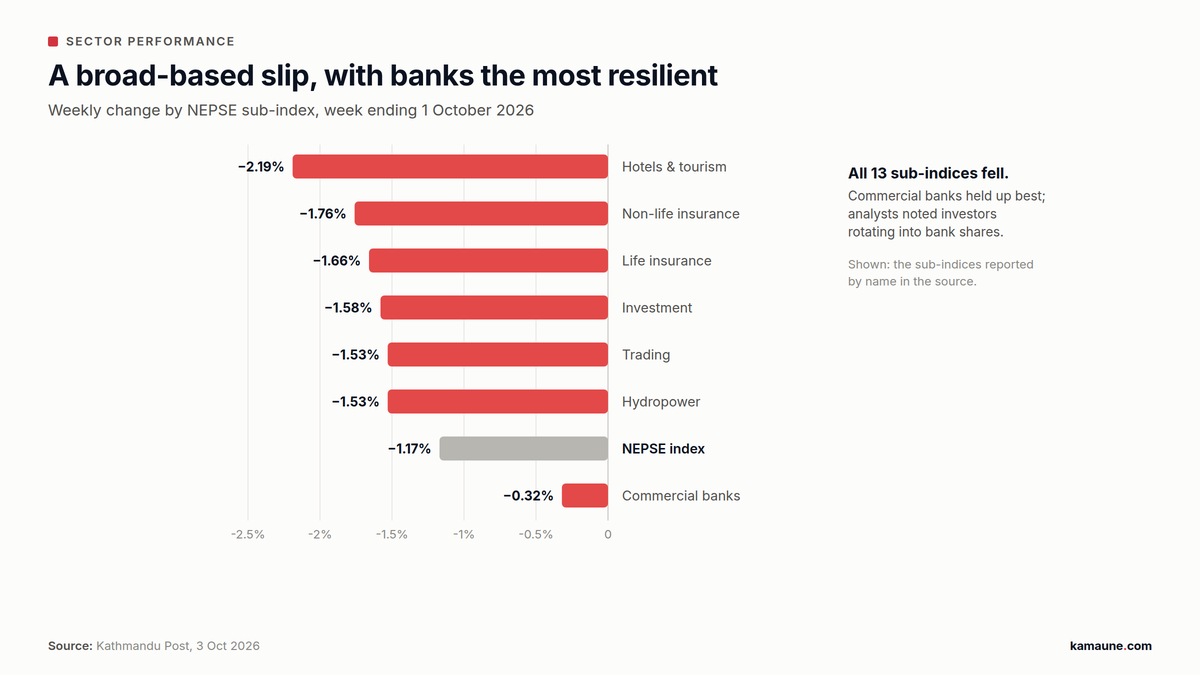
Not every sector is weak. Commercial banks fell only 0.32% in the latest week while all 13 sectors declined. Hydropower companies with new capacity reported big profit gains, though hydro shares still fell in the late-August floods and the latest week. The broad picture is caution, not panic.
10 reasons why NEPSE is falling
1. Investor confidence broke after the change of government
What's happening: The March rally was driven by hope that a strong, stable government would be good for business. Within days, that hope collided with headline arrests of prominent investors. Then came a Rs 22.39 billion money-laundering and circular-trading case filed against 34 people in June (Himal Press), and a separate property-investigation drive.
What the data shows: NEPSE fell 3.79% on 5 April, with 261 of 268 stocks closing red. Brokers and investor groups quoted by the Kathmandu Post (13 July) tied the decline directly to fear among large investors. The investigations, they said, "mainly increased fear among large investors."
Why it matters: In Nepal's market, a relatively small group of large investors moves prices. When they step back, nobody absorbs the selling.
Our view: Cleaning up manipulation can be good for the market's long-term health. In the short term, though, it removed some of the market's most active buyers.
What to watch: How the investigation cases are resolved, and whether large-investor activity (block trades, turnover in large banks) picks up.
2. Buyers have gone missing more than sellers have flooded in
What's happening: The market isn't falling because of panic selling. It's falling because few people are willing to buy.
What the data shows:
- Turnover has collapsed. The average daily figure dropped from about Rs 13 billion before the new government to Rs 5.6 billion by July, and to Rs 4.5 billion in the week ending 1 October. Compare that with record days of Rs 29.95 billion (15 August 2024) and Rs 23.59 billion (22 March 2026).
- Few accounts are active. SEBON counts 8.095 million demat accounts and 3.56 million trading accounts (ShareSansar, 30 Sep 2026), but only about 400,000 investors are active, according to the Kathmandu Post.
- Analysts see a demand gap. Analyst Manish Aryal has said the market needs roughly Rs 8–10 billion of daily turnover to sustain a rise.
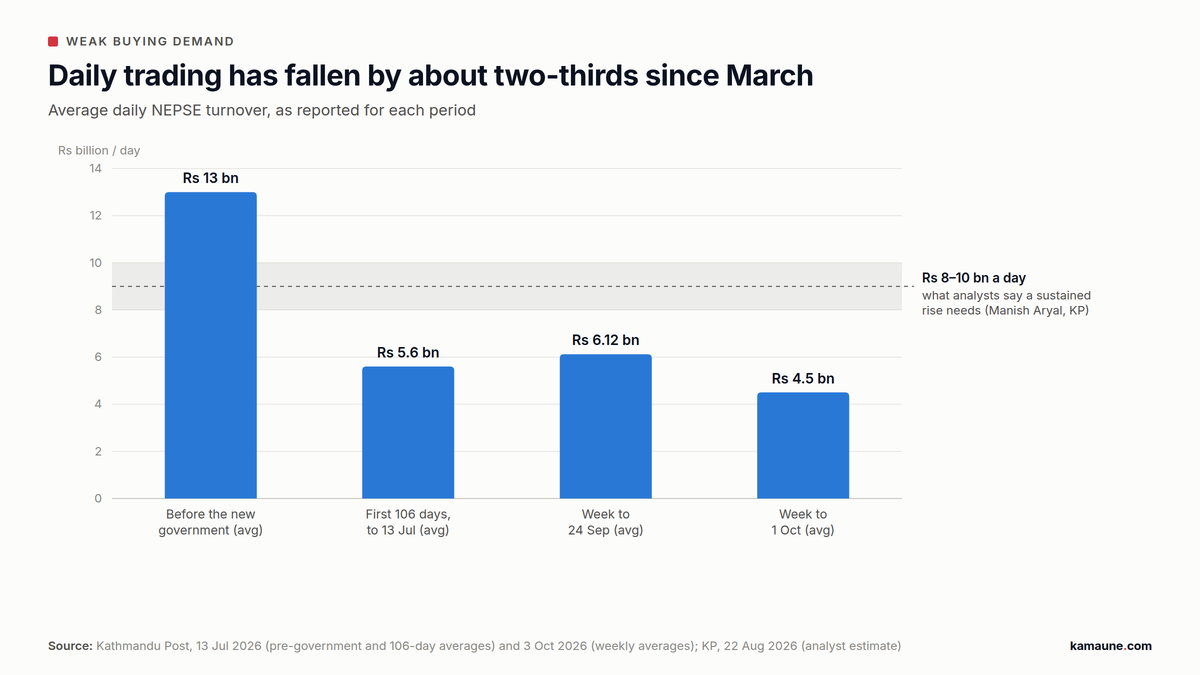
Why it matters: When volume is low and prices fall, it usually means buyers are absent rather than sellers rushing for the exit. Even modest selling then pushes prices down.
What to watch: A sustained return of daily turnover above Rs 8–10 billion would be the clearest sign that demand is back.
3. Banks are full of cash, but it isn't reaching the stock market
What's happening: Nepal's banking system has a huge cash surplus.
What the data shows:
- Excess reserves: Nepal Rastra Bank estimated Rs 1.1 trillion in mid-May 2026. Media estimates for July to September range from Rs 1.3 trillion to Rs 1.56 trillion, using different definitions.
- Interbank rate: it has sat at the corridor floor of 2.75%.
- NRB absorption: the central bank is still pulling money out of the system, including a Rs 30 billion deposit auction on 28 September (ShareSansar).
- Margin lending: loans against shares grew 18.3% in fiscal year 2025/26, faster than total credit (NRB annual report).
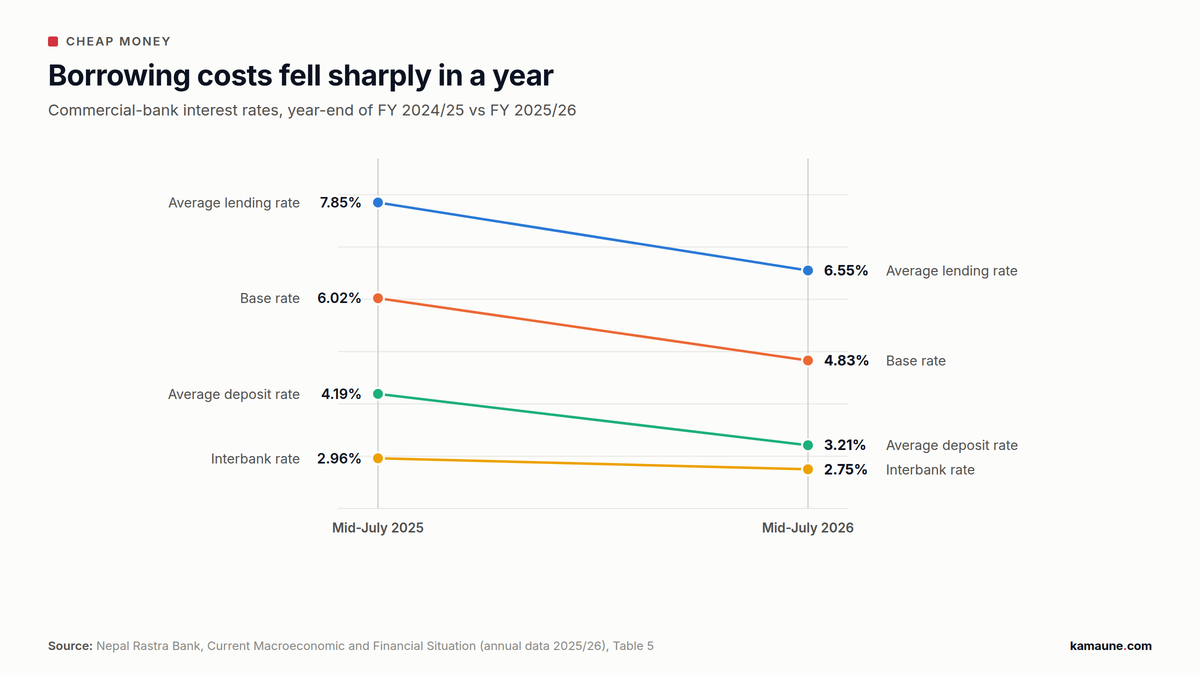
Why it matters: Liquidity in banks is not the same thing as demand for shares. Bank cash reaches NEPSE only when a borrower decides to take a share-backed loan, or when depositors move savings out of deposits into stocks. The margin-lending figure is important here. Credit for buying shares is available and growing. The bottleneck is appetite, not access to money.
What to watch: Whether margin lending keeps growing alongside rising turnover, which would signal that leverage is going back to work.
4. Credit growth is running at about half the target
What's happening: Businesses aren't borrowing to expand.
What the data shows:
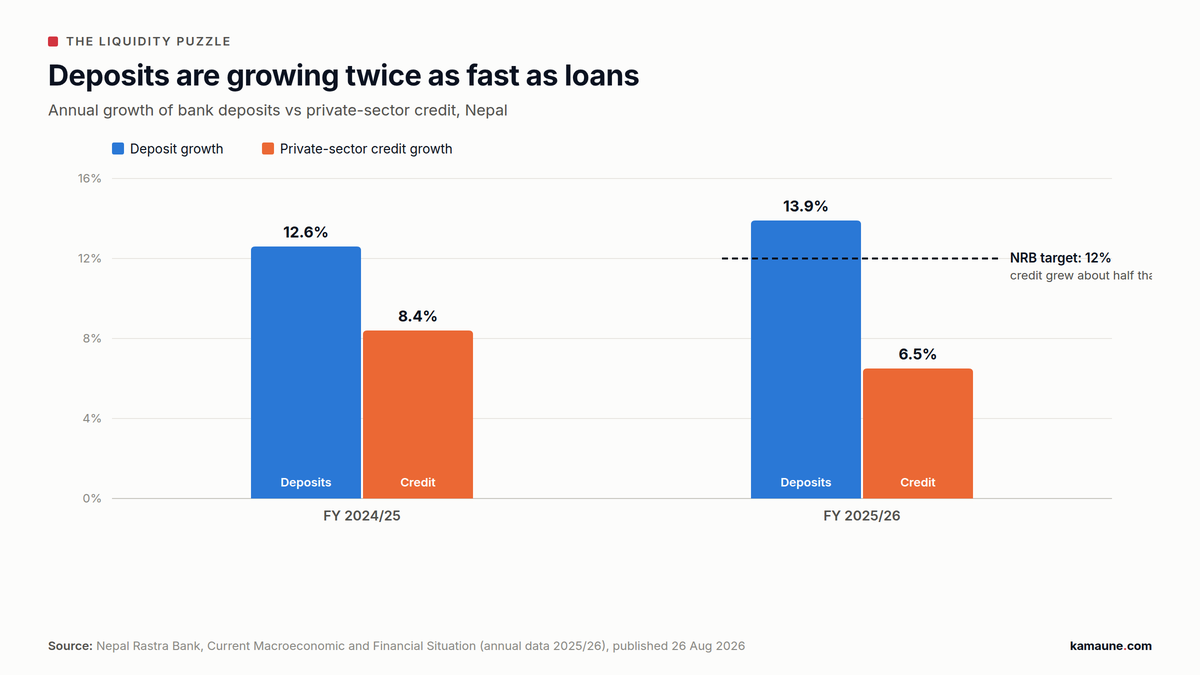
- Credit growth: private-sector credit grew just 6.5% in fiscal year 2025/26, against NRB's 12% target and down from 8.4% the previous year.
- Deposit growth: deposits grew 13.9% over the same year.
- This year so far: by mid-August 2026, credit growth was about 7% year on year, and NRB has trimmed this year's target to 11%.
- Lending ratio: the credit-to-deposit ratio for commercial banks is only 69.90%, far below the 90% ceiling (NRB Banking & Financial Statistics, Asar 2083).
- NRB's explanation: in its July 2026 macroeconomic report, NRB says credit has been held back by "private sector resistance, stricter credit prudence, and declining asset quality."
Why it matters: The chain runs like this:
- Weak loan demand means banks earn less interest income. Commercial banks' interest income fell about 8.7% last fiscal year.
- Weak business borrowing also means less business expansion.
- That means slower earnings growth for listed companies.
- That leaves investors with less reason to pay higher prices.
None of these links is instant or mechanical, but together they cap investors' optimism. Santosh Koirala, president of the Nepal Bankers' Association, told the Kathmandu Post that industries are running "at less than half their capacity."
What to watch: Monthly credit growth in NRB's macroeconomic updates. A move back towards double digits would matter.
5. Earnings aren't collapsing, but valuations are stretched and bad loans are rising
What's happening: You might expect falling profits to explain a falling market. The truth is more nuanced.
What the data shows (fiscal year 2082/83, ended mid-July 2026):
- Commercial banks: combined net profit was about Rs 69.8 billion. Media reports compared this with a restated previous-year figure and reported +32% growth (ShareSansar). Against the previous year's figure in NRB's statistics (Rs 71.5 billion), profit was about 2% lower. The likely reason is restatement of the earlier year's accounts after audit. Either way, the average bank EPS was only about Rs 18.64.
- Bad loans are rising:
- Commercial-bank NPLs rose from 4.44% to 5.56% in a year.
- Four banks, including NIC Asia and Himalayan Bank, ended the year with negative distributable profit, limiting their dividend capacity.
- Other sectors were mixed:
- Development banks: profit rose about 57%.
- Microfinance: profit rose about 36%.
- Hydropower: companies with new capacity posted big gains, helped by record electricity exports of Rs 29.32 billion.
- Non-life insurance: profit fell about 39%.
- Life insurance: profit was slightly down.
- Valuations are high:
- In April 2026, NEPSE traded at about 38 times trailing earnings, against about 13 times for MSCI Frontier markets and 20 times for India (ShareSansar).
- A July analysis put commercial banks at a median P/E of about 18.7, but hydropower at 64, life insurance at 57 and non-life insurance above 100.
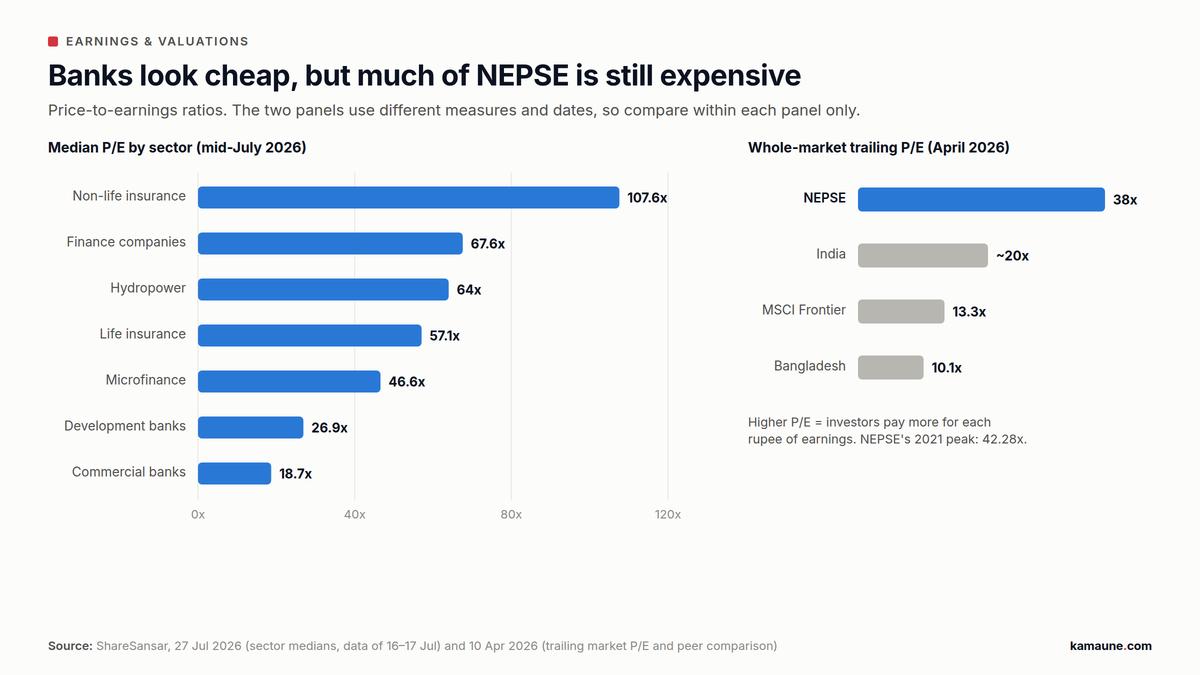
Why it matters: At these prices, investors are already paying for a lot of future growth. Earnings that are merely steady, plus rising bad loans, don't justify paying more. That is why money is rotating towards banks, which are relatively cheap, and away from richly priced insurance and hydro stocks.
What to watch: First-quarter 2026/27 results (the quarter ends mid-October), NPL trends and dividend announcements.
6. The "3,000 ceiling": investors who bought high are waiting to sell
What's happening: NEPSE has approached 3,000 three times in five years and failed each time:
- 3,198.60 in August 2021 (the all-time high)
- 3,000.81 in August 2024
- about 2,974 in July 2025
- 2,950.50 in March 2026
What the data shows: Many investors bought near those peaks and are still underwater. Traders call this overhead supply: when prices recover towards an investor's purchase price, they sell to break even, and that selling caps every rally. Analyst Ajay Singh Thapa described exactly this behaviour to the Kathmandu Post in August. After three to four years of poor returns, many investors simply want to exit. Expiring lock-in periods on promoter shares, especially in hydropower, add more potential supply.
Why it matters: Rallies run into a wall of sellers before they can build momentum.
What to watch: Whether NEPSE can close above previous rally peaks such as 2,680 and 2,750 on strong turnover, rather than on thin volume.
7. The tax and policy shocks unsettled the market, even though the government itself is stable
What's happening: The government itself is not unstable. The RSP holds an outright majority. The uncertainty is about policy:
- Capital gains tax increase: the 29 May budget raised capital gains tax on listed shares from 7.5% to 10% for holdings under a year, and from 5% to 7.5% for longer holdings (ShareSansar). NEPSE fell on 9 of the next 12 sessions.
- No SEBON chair: the regulator went about two months without a permanent chair after Santosh Narayan Shrestha resigned in April, until Dr Gopal Prasad Bhatta was appointed on 19 June.
- IPO backlog: about 108 public issues were waiting for approval in September.
- FATF grey list: Nepal remained on the list after the June 2026 plenary.
What the data shows: The policy direction has since turned. On 14 September, the Finance Ministry issued a 21-point capital-market action plan (Kathmandu Post). It proposes:
- cutting capital gains tax to 3.75% (held over 365 days) and 5% (365 days or less)
- opening the secondary market to non-resident Nepalis
- channelling pension and insurance funds into equities
These are proposals with deadlines. Several of them need changes to the law and are not yet in effect.
Why it matters: Markets dislike not knowing the rules. When tax rates or listing rules can change suddenly, investors demand a discount, or they simply wait.
What to watch: Whether the capital gains tax cut and the non-resident access amendment actually pass, and on what timeline.
8. The charts show weak momentum, not a clear trend
What's happening: Technical indicators summarise how buyers and sellers are behaving. They don't predict the future.
What the data shows (Kathmandu Post, week ending 1 October 2026):
- Moving averages: NEPSE closed below both its 20-day EMA (2,619.73) and its 50-day EMA (2,602.99). A moving average shows the average price over a set period, so trading below it means recent prices are weaker than the recent average.
- RSI: the 14-day RSI was 45.26 and falling. Below 50 means sellers have had slightly more control recently.
- Support and resistance: analysts place support around 2,500–2,520 and resistance at 2,620 and then 2,680. Support is a level where buyers have previously stepped in; resistance is where sellers have.
Why it matters: The weakening RSI and the index's position below its moving averages suggest momentum has deteriorated. That reinforces the cautious mood rather than causing it.
What to watch: How the index behaves around the 2,500–2,520 support zone, and whether it can reclaim its moving averages.
9. System glitches have chipped away at trust (a minor factor)
What's happening: In 2026, several system problems hit the market:
- In January, a broker technology provider's TMS malfunction stopped 13 brokers from trading.
- The index display showed false crashes on more than one occasion.
- Most seriously, a ransomware attack on Data Hub, which hosts trading servers for 72 brokers, forced NEPSE to halt all trading on 21 September 2026 (Kathmandu Post). Trading resumed the next day, and SEBON ordered an investigation.
What the data shows: We found no report of investor funds being lost. Each incident was resolved within about a day.
Why it matters: These glitches did not cause the decline. They do add to a sense that the market's plumbing isn't reliable. In late September, Parliament's Finance Committee also flagged CEO vacancies at both NEPSE and CDSC.
What to watch: The findings of SEBON's investigation, and any upgrade of the trading and data-centre systems.
10. No single catalyst is strong enough on its own
What's happening: Bull markets usually need several positive forces at once. Here is where Nepal stands:
| Ingredient | Current status | Supportive? |
|---|---|---|
| Low borrowing costs | Average lending rate 6.55% (from 7.85%) | Yes |
| Liquidity | Rs 1.1–1.35 trillion surplus | Yes |
| Remittances and FX reserves | +37.1% remittances; about 19.6 months of import cover | Yes |
| Credit growth | 6.5% vs 12% target | No |
| Economic growth | 3.85% (fiscal year 2025/26 estimate) vs 7% target this year | Weak |
| Corporate earnings | Mixed; NPLs rising | Mixed |
| Investor participation | About Rs 4.5 billion daily turnover; about 400,000 active investors | No |
| Policy confidence | Reform plan announced but not yet implemented | Improving, unproven |
| Institutional/foreign money | Planned, not yet flowing | Not yet |
Why it matters: Cheap money alone produced a rally in 2021 because almost everything else lined up at the same time. Today, half the table is still red.
What to watch: How many rows turn green over the next two to three quarters.
If Nepal has so much liquidity, why isn't NEPSE rising?
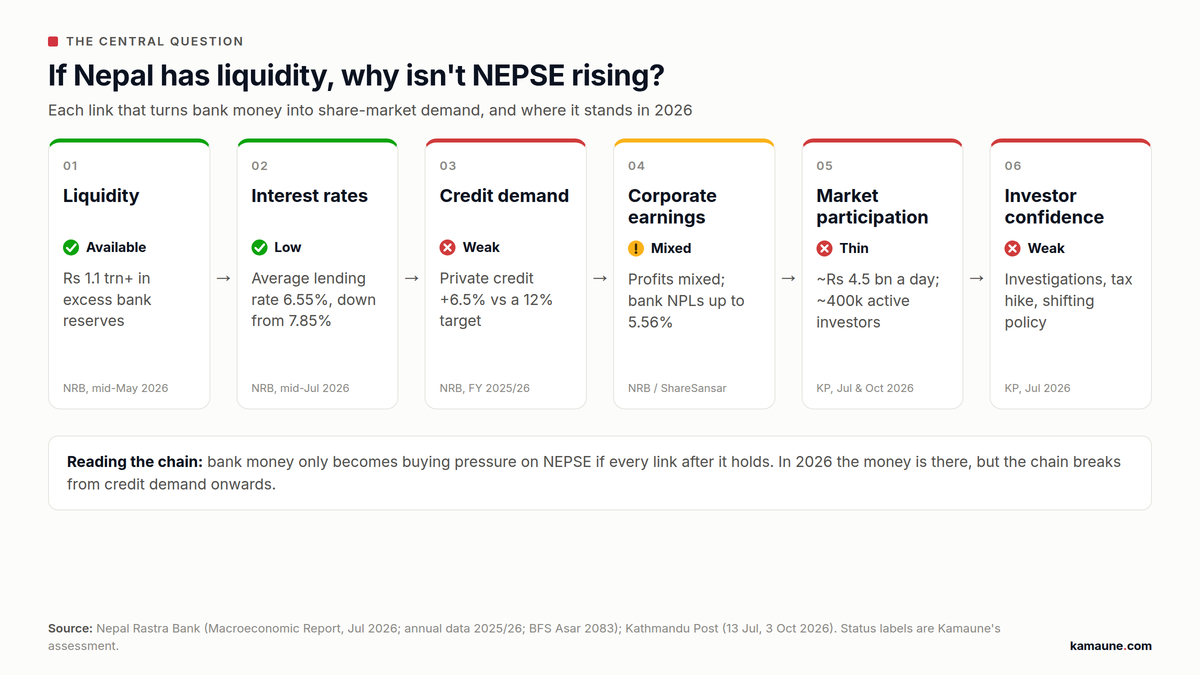
This is the question most investors are asking. The answer is that liquidity is only the first link in a chain, and in 2026 the chain is broken in several places.
| Link | Status (latest) | What it means |
|---|---|---|
| Liquidity | Rs 1.1 trillion+ excess reserves; interbank rate 2.75% | Money is available |
| Remittances | Rs 2,363 billion in fiscal year 2025/26 (+37.1%) | Households have more income |
| Interest rates | Lending 6.55%, deposits 3.21% | Borrowing is cheap; saving pays little |
| Credit demand | +6.5% vs 12% target | Businesses aren't borrowing |
| Economic growth | 3.85% | Activity is subdued |
| Corporate earnings | Flat to mixed; NPL 5.56% | Not enough growth to justify higher prices |
| Market participation | About Rs 4.5 billion a day; about 400,000 active investors | Few buyers |
| Investor confidence | Investigations, tax hike, policy changes | The decisive missing link |
Our view: Liquidity gives people the ability to buy shares, and confidence gives them the reason. In 2021, low rates, idle money and optimism all arrived together. In 2026, the money is there, but the reasons aren't yet:
- Businesses won't borrow without demand.
- Earnings won't grow quickly without credit.
- Big investors won't commit while investigations and tax rules are still shifting.
Rising remittances mostly go into consumption, deposits and real estate. Only a small share reaches equities, and that share shrinks when sentiment is poor.
There is also a policy limit. Inflation rose to 5.96% in mid-August 2026, up from 1.68% a year earlier. That reduces NRB's room to push rates even lower, so "cheaper money" is unlikely to be the trigger on its own.
What could help NEPSE recover?
None of the following is a forecast. These are the developments that, according to the data above, would address the weak links:
- Credit growth picks up. A sustained return to double-digit growth would signal real business demand.
- Earnings beat expectations. In particular, NPLs need to stabilise and bank interest income needs to recover.
- Reforms are implemented. That means passing the capital gains tax cut, non-resident access and institutional investment rules, not just announcing them.
- Turnover returns. Daily trading needs to get back to the Rs 8–10 billion range analysts associate with rising markets.
- Regulation becomes clearer. That includes finalising IPO guidelines and resolving high-profile investigations.
- Economic growth recovers towards the government's 7% target. Independent forecasters such as ADB expect less, around 5%.
- Infrastructure trust improves. That means permanent CEOs at NEPSE and CDSC and hardened trading systems.
What should investors watch next?
- NEPSE turnover: sustained Rs 8–10 billion a day or more
- Banking liquidity: NRB absorption amounts and the interbank rate
- Credit growth: the monthly figure in NRB's macroeconomic updates
- Interest rates: the base rate and average lending rate (and inflation, which limits further cuts)
- Corporate earnings: first-quarter 2026/27 results, NPLs and distributable profit
- Investor participation: active accounts and margin-lending growth
- Policy: progress on the capital gains tax amendment, non-resident access and SEBON's IPO rules
- Remittances and FX reserves: monthly NRB data
- Sector rotation: banks vs hydropower vs insurance
- Technical levels: support at 2,500–2,520 and resistance at 2,620 and 2,680
If you're new to placing trades, our guide on how to buy and sell shares in Nepal explains the mechanics. For how the tax changes affect your returns, see our share market tax guide.
Frequently Asked Questions
Why is NEPSE falling in 2026?
NEPSE fell about 12% from its 26 March 2026 high of 2,950.50 because confidence weakened after investigations into large investors, the capital gains tax was raised in the 29 May budget, and buying demand dried up. Daily turnover dropped from about Rs 13 billion to Rs 4.5 billion. Weak credit growth and stretched valuations also limit gains.
Why is NEPSE not rising despite excess liquidity?
Excess liquidity only means banks have money to lend. It reaches stocks when investors choose to borrow or shift savings into shares. With weak confidence, slow credit demand (6.5% growth against a 12% target) and high valuations, that money mostly stays in the banking system.
Will NEPSE recover?
No one can say when. A sustained recovery would likely need several things together: stronger credit growth, better earnings, higher turnover and the proposed reforms actually being implemented. Treat any confident prediction with caution.
What is causing Nepal's stock market weakness?
It is a mix of weak investor confidence, low trading volume, credit growth at about half the target, rising bad loans, high valuations, selling by investors who bought near previous peaks, policy and tax uncertainty, and occasional system disruptions.
Do lower interest rates help NEPSE?
They help, but not on their own. Lower rates make borrowing cheaper and deposits less attractive. Nepal's lending rate fell to 6.55% in 2026, but without business demand and investor confidence, cheap money hasn't moved into shares.
How are bank liquidity and NEPSE related?
Liquidity can flow into NEPSE through margin loans and through savers moving from deposits into shares. That link depends on investor appetite. In fiscal year 2025/26, margin lending grew 18.3%, but overall market turnover still fell, so access to money isn't the bottleneck.
What factors can push NEPSE higher?
Stronger corporate earnings, double-digit credit growth, higher daily turnover, clear and stable tax rules, institutional investment from pension and insurance funds, access for non-resident Nepali investors, and faster economic growth.
Conclusion
NEPSE isn't falling for lack of money. It is struggling because almost every link between money and share prices is weak at the same time: borrowing, growth, earnings, participation and above all confidence. Until more of those links strengthen together, rallies are likely to keep running into sellers. Watching the indicators above will tell you more than any single prediction.
This article is educational, not financial or investment advice. Figures are as of the dates stated and change frequently. Verify with NEPSE, Nepal Rastra Bank or SEBON, or consult a qualified professional, before making decisions.
Get NEPSE explained without the jargon, every week. Join the Kamaune newsletter. New to investing? Start with how to invest in the share market in Nepal.